

|
|
|
 |
|
Area |
: |
1,330 sq km
(park);2,585 sq km (reserve) |
|
Altitude |
: |
0-10 m above sea
level |
|
Languages |
: |
Spoken Bengali,
Hindi, English |
|
Annual Mean Rainfall |
: |
1,108 mm (Canning) |
|
Maximum Temperature |
: |
Summer 42°C |
|
Minimum Temperature |
: |
Winter 9.2°C |
|
|
|
|
|
The word "Sunderban" is
derived from sundari and ban, which, when combined, means
"the forests of sundari"-an obvious reference to the large
mangrove trees. |
|
The 1,330 sq km area of
Sunderbans was established as a National Park on May 4,
1984. The Sunderbans had earlier been designated as a Tiger
Reserve in December 1973. After this, a wildlife sanctuary
was created in 1977. |
|
The word "Sunderban" is
derived from sundari and ban, which, when combined, means
"the forests of sundari"-an obvious reference to the large
mangrove trees. |
|
The 1,330 sq km area of
Sunderbans was established as a National Park on May 4,
1984. The Sunderbans had earlier been designated as a Tiger
Reserve in December 1973. After this, a wildlife sanctuary
was created in 1977. |
|
 |
|
Due to its proximity to the
Bay of Bengal, Sunderban experiences very high humidity.
Rainfall is quite heavy during monsoon, which last from
mid-June to mid-September. After the monsoons, fair weather
prevails until mid-March. |
|
The best season to visit the
Sunderban is between October to Marchs |
|
 |
|
Moving through the largest
estuarine delta in the world is quite a
thrilling
experience. The flora and fauna of the region are the major
attractions here. The mangrove forest presents a unique
ecosystem. The wildlife includes the world famous Royal
Bengal Tiger, a major attraction in the tiger reserve. Some
of the other attractions include chital, crocodile, monkeys,
estuarine and marine turtle, dolphins and various kinds of
birds. The Bhagabatpur Crocodile Project besides being a
hatchery and a sanctuary is the home to the biggest
estuarine crocodiles. |
|
Top |
|
 |
|
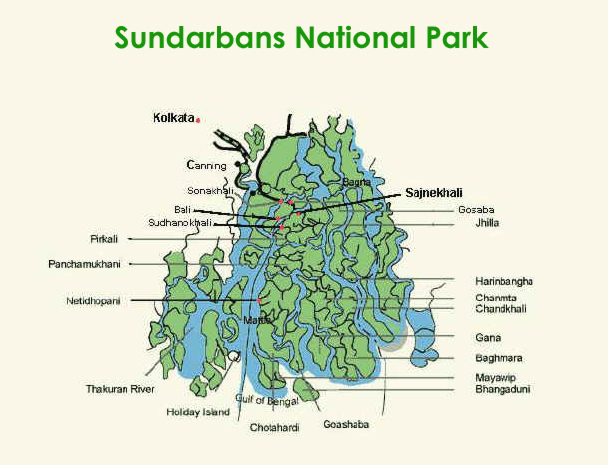
The Sajnekhali Bird Sanctuary
is situated on the confluence of Matla and Gumdi within the
buffer zone that extends over an area of 885 sq km. Here you
can have a look at the wide variety of birds, the most
popular among them being the spotted billed pelican, cotton
teal, herring gull, Caspian tern, grey heron, large egret,
night heron, open-billed stork, white ibis, common
kingfisher, brahmini kite and paradise flycatcher. A rare
winter migrant, Asian dowitcher (Limnodromus semipalmatus),
can also be found here. |
|
Among the birds of prey are
osprey (Pandion haliaetus), Pallas's fish eagle (Haliaeetus
leucoryphus), white-bellied sea eagle (Haliaeetus
leucogaster), grey-headed fishing eagle (Ichthyophaga
ichthyaetus), peregrine falcon (Falco peregrinus), Oriental
hobby (Falco severus), northern eagle owl (Bubo bubo) and
brown fish owl (Ketupa zeylonensis). |
|
 |
|
The reserve comprises a core
zone, afforestation zone and restoration zone and an agri-operation
zone. The core zone of 1,300 sq. km represents the National
Park and the rest of the
area is used for the forestry
operations. The variety of the forests that exist in Sunderban include mangrove scrub, littoral forest, saltwater
mixed forest, brackish water mixed forest and swamp forest.
The flora includes genwa,
dhundal, passur, garjan and kankra. The goran trees, whose
average height varies between 1.8 metres and 3.6 metres,
cover almost the entire region.
|
|
The tigers form the major
source of attraction in the reserve here. The 1980 census
put the population of tiger in this reserve close to 400.
Besides the tiger, you can have a look at the Gangetic
dolphin, little porpoise, fishing cat, Indian fox, jungle
cat, small Indian civet, common grey mongoose, spotted deer,
wild pig, Indian flying fox, rhesus monkey and pangolin
|
|
Sunderban is also the breeding
ground of a large variety of birds. Out here, you get to see
heron, egret, cormorant, fishing eagle, white-bellied sea
eagle, seagull, tern and kingfisher. The migratory birds
like whimprel, black-tailed godwit, little stint, eastern
knot, curlew, sandpiper, golden plover, pintail, white-eyed
pochard and whistling teal also flock this place. The place
is also home to the wide variety of aquatic and reptile life
forms that include Olive Ridley sea turtle, hardshelled
batgur terrapin, pythons, king cobra, chequered killback,
monitor and lizards. |
|
 |
|
The Bhagabatpur Crocodile Project besides
being a hatchery and a sanctuary is the home to the biggest
estuarine crocodiles. You can access this place through
Namkhana. |
|
A Community
Tourism initiative of Help Tourism |
|
Accommodation: |
|
We have our own Eco Lodge at
Bali Island named Sunderbans Jungle Camp.06 ethnic
cottages(04 Three-bedded+02 Four-bedded) that respect local
rural architecture and constructed with local materials.
Spotless rooms with modern bath. Large dining. A fishing
deck. Surrounded by lush green village gardens, trees,
pond-over looking the |
|
Sanctuary on the bank of river
Gumdi. Powered by pollution-free solar energy with powerful
generator back up (battery can be charged).Safe drinking
water and clean, local food. The people of Bali village are
your host. They are the transformed conservationists and
gainfully involved in the camp. They will take you around
the forest or on a cruise through the creeks or help you
have authentic encounters with the people of Sunderbans.
They will tell you the story of tigers, birds, flora. They
are the people who know the address of each and every turn
of the river, and every creek. |
|
Cruises: |
|
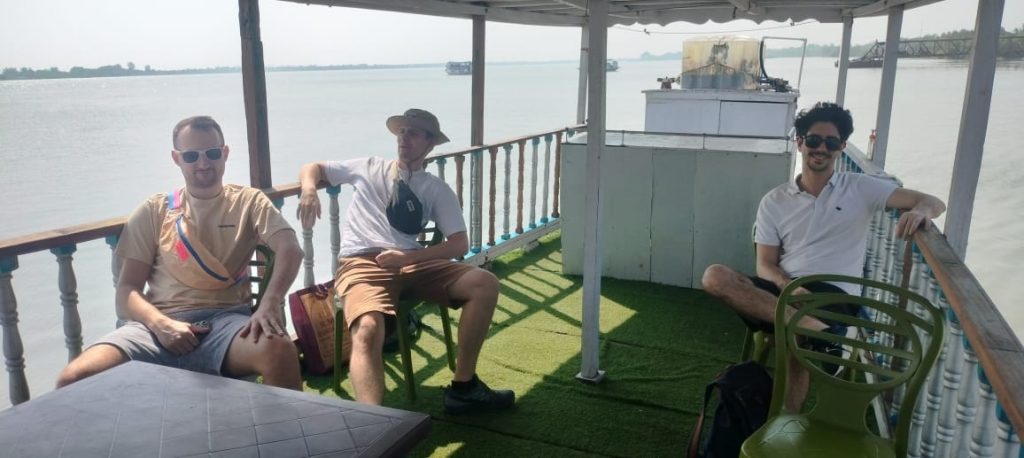
We have 02 powerful 4 cylinder
boats and One 2 cylinder boat for short and long cruise. Our
sarengs (Pilots) are experienced. Both the boats are as good
and comfortable with |
|
Cabins and modern toilets.
Life jackets that meet international norms of quality and
coastal safety are provided during cruise and country boat
ride. |
|
The food: |
|
We serve local dishes
specially and tastefully cooked for you by our trained local
chef. Much variety is not possible owing to the remoteness
of the area, yet best possible food is provided under strict
hygienic supervision. Vegetables come from the organic
gardens of the village, fresh fish and crab from the rivers
and ponds, chicken from the village farms and fresh honey
from the honey collectors' houses. |
|
The
Activities: |
|
We do not operate Tiger tours
and discourage any form of Tiger shows. For those who
consider Tiger sighting a must for their trip are
discouraged to join our cruise safaris as Tiger sighting
cannot be guaranteed in such a vast, remote and difficult
terrain where visitors hardly have any opportunity to walk
on the forested lands or mud flats. We welcome all to our
Natural History tour for a great learning experience and a
mutual education. Our project and tour is extremely
environmentally-sensitive and has strong conservation and
benefit sharing pledge. |
|
Top |
|